|
|
||||||||||||||||||||||||||||||||||||||||||||||||||||||||||||||||||
|
|
On the Feasibility to Deploy Mobile Industrial
Applications using Wireless Communications Wireless
communications can facilitate the deployment of novel industrial applications
to improve productivity or health and safety conditions. Health and safety
applications require mobile solutions capable to operate under harsh
propagation conditions at low cost and energy consumption. The work in:
presents
the results of an extensive measurement campaign that demonstrate the
feasibility to deploy industrial mobile sensing applications with reliable
wireless connectivity levels using short-range IEEE 802.15.4. The campaign
also analyses the capability of various wireless technologies to provide the
throughput levels necessary for wireless local data distribution and backhaul
connectivity. The
field testing campaign has been conducted as part of the FASyS project (Absolutely Safe and Healthy
Factory). FASyS is investigating the design of an end-to-end heterogeneous
wireless solution for continuously sensing the working environment and the
workers’ health and physiological conditions in order to be able to detect in
advance any potential risks. This research aims to complement the existing
studies with an extensive measurement campaign that, for the first time,
evaluates the performance of wireless off-the-shelf devices for mobile
sensing applications in industrial environments. The study is not limited to
communications performance metrics, but also implements three significant
safety-related industrial mobile applications. The obtained results provide
important indications on the industrial wireless communications performance
under mobile conditions. The
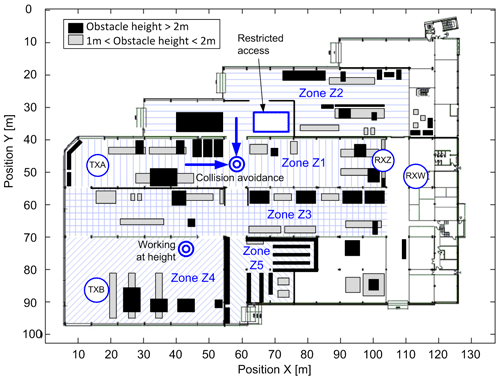
field testing campaign has been conducted in the main factory of GORATU, an
important Spanish manufacturer of machine tools. Covering a surface area of
more than 10.000m2, the factory has a perimeter wall and a
building height of around 11m. The interior of the plant mainly consists of
wide corridors and large rooms typically separated by concrete walls of
around 2m height. The corridors are machinery assembly areas, and typically
present large metal pieces whose spatial distribution at the time of
conducting the measurement campaign is shown in the following figure. The
receiver nodes are placed at fixed positions (RXZ and RXW in the figure). On
the other hand, the transmitter node is mobile, and moves around different
areas of the factory characterized by varying operating and propagation
conditions.
This
website provides access to additional graphic material about the performed
field testing campaign in order to provide complementary information and
facilitate the understanding of the conditions under which each test was
conducted. To to facilitate wireless industrial communications research
activities based on the results of the conducted measurement campaing, the
obtained traces are available upon request.
Four
different types of traces are available, one for each technology evaluated in
the paper. The following tables detail the data available in each type of
trace. The data is provided in plain text so they can be easyly read with
Matlab/Octave or any other processing tool. The IEEE 802.15.4 and IEEE 802.11
traces have one row for each correctly received packet (erroneous packets are
not included in these traces). The IEEE 802.16 and UMTS traces have one row
every T=1s and T=200ms, respectively. IEEE
802.15.4/Zigbee traces
IEEE
802.11/WiFi traces
IEEE
802.16/WiMAX traces
UMTS/HSDPA
traces
Insert
the code provided by email to access the traces and graphical material: |
|||||||||||||||||||||||||||||||||||||||||||||||||||||||||||||||||